Stateless
As part of the Akha people, Maxdo, his wife, and eldest daughter are stateless, even after Maxdo has lived in Thailand for 16 years. They continue to live with limited rights and economic challenges but hold on to their culture through farming, community, and Christian faith. However, the future of preserving their traditions and culture is uncertain, as the younger generations gain better opportunities and move away from the mountains.
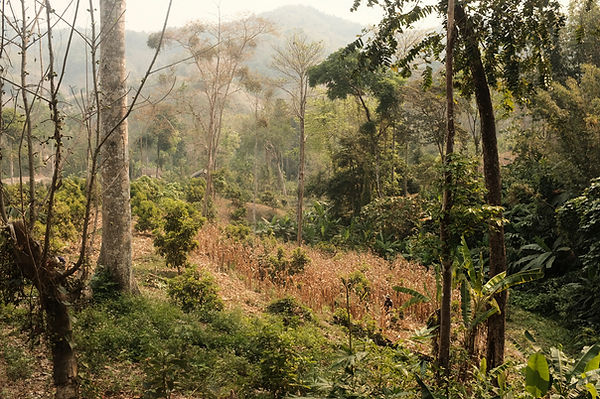
The noise from the brushcutter cuts through the heavy, humid mountain air just as it slices through the dry maize stalks covering the hillside. The sun is high, and the heat presses down over the fields. Rows of avocado and durian trees stretch up the slopes.
Here, in the shade on the mountainside, a family works without pause. Maxdo Mayeur grips the 9 kg brushcutter strapped over his shoulder, cutting the overripe maize plants that will soon fertilise the trees.
Meanwhile, his wife, Akum, and their eldest daughter, Abeh, move through the piles of dry branches and leaves, dragging the heavy plant cuttings to the roots of the avocado trees.
It is a rhythm they know all too well. Among the felled maize plants and banana palms, they move as part of the landscape. A job with few breaks, no choices. Six days a week, from sunrise at 8 to just before sunset at 5. From morning to evening, they work the mountainsides under the red sun. They have no other option as refugees from Myanmar. As stateless people, they have found a kind of stability in the work, a way of managing daily life they can endure.

55-year-old Maxdo Mayeur came to Thailand to create a better future for his family. In Keng Tung, Myanmar, there were no opportunities left no safety due to the country’s long civil war.
Maxdo, like many other members of the large Akha ethnic group, had no choice but to flee in order to survive.
He and his family hoped for a new life in Thailand, a country that, on the surface, promised safety and opportunity, but in reality turned out to be far more complex.
“When I first came to Thailand, I lived higher up in the mountains and closer to Myanmar,” says Maxdo.
When he first arrived, he started a tea plantation. A plantation he established without permission, as he had to find some way to secure daily income for his family. It was best to do so in an area where few, if any, people could find their way to.
He and his family still have limited options. They have few rights, no citizenship, no real security. Only the land which is not truly theirs and the work they can likely never escape. Maxdo has lived in Thailand for 16 years, but his status remains unchanged. He exists, but he doesn’t truly belong, not in the country of Thailand. But in this area, he is not alone.

Maxdo and his three youngest children live in their homemade, self-built wooden house, where, together with around 150 other Akha people, they reside in the village of Ban Pong Nam Ron in the Doi Hang area.
It’s a house where the kitchen is just as much outside as it is inside, and where meals are often made from what one finds and prepares rather than buys. The water from the tap is the same as the water flowing down the waterfall further up the mountain.
A life of farming
Maxdo’s life is closely tied to and deeply dependent on his work in the fields. Each morning starts early with boiling rice to be eaten with leftovers from the day before. He then drives 20 minutes down the steep mountain roads on his scooter. He starts the brush cutter, which runs almost non-stop to clear the farmland and prepare the fertiliser before the rainy season for the next crop.
The work is physically demanding and lasts as long as the sun is in the sky. The fields belong to Maxdo’s younger brother’s wife and her family. Although Maxdo has his own small tea farm, he has for years depended on this work on others’ land to support his family.
“I’ve worked in these fields for 3 years; before that, I tended to my tea farm.”
The machine’s constant vibrations and the tough physical labour are familiar to his hands. They are hardened by the work, and his skin is leathery from the sun. With a daily wage of 350 baht, around 71 Danish kroner, it barely covers the basic necessities. But he knows that what he does is not only necessary, it is also, to a great extent, his pride.
“I don’t have other opportunities to work elsewhere, but I’m also happy with this,” says Maxdo.

By the fields, there are two small open bamboo huts where he, his wife Akum, and their eldest daughter Abeh take lunch breaks during the hottest time of the day. But even here, rest is hard to find, the breaks are short, and the work still demands their attention. The breaks are spent planning which part of the field they need to focus on next.
“We still need to collect on the left side of the trees up there,” says Abeh.
As stateless people, they do not have the right to own land, making them dependent on kind acquaintances who offer them work.
Statelessness among the Akha people remains widespread, and their status makes them invisible in the system. Over time, they have also lacked access to healthcare and the ability to send their children to school, leaving them at the mercy of the authorities. Rights are improving for most, but many still do not officially exist.
For Maxdo, it has meant a lifelong struggle for stability. He came here hoping for a better life, but without the right papers, he is forced to take whatever work he can find.
The large family and future generations
Maxdo, Akum, and Abeh have obtained a 10-year temporary residence permit, which they cling to while waiting for an answer on permanent residency. The temporary permit, however, gives them access to the healthcare system on the same terms as Thai citizens something that was very different just a few years ago.
Back then, a visit to the doctor or buying medicine cost hundreds of times more than it does now, when they can afford the necessary treatment.
His eight children are also affected by statelessness. Even though the youngest were born in Thailand, they have no automatic right to citizenship. Without documents, they cannot travel, gain formal employment, or pursue higher education without facing significant challenges.
The family is, however, fortunate. Thanks to good agreements between the school, local government, and the Akha community in the area, they have regained some rights, making it possible for Maxdo’s children to study in Chiang Rai.

The agreement between the local school and the municipality is highly valued by Maxdo’s family. Even though most of his children are now adults, the three youngest still attend the local school.
“It’s important that they can go to school. I hope they can have a better life than me,” says Maxdo.
Education and the school
Children from the town of Ban Pong Nam Ron and the surrounding villages attend the only school located in the three mountain villages. The school is further down the road, a 10-minute scooter ride from Maxdo’s house, if you’re experienced on the winding roads.
However, educational opportunities are limited, and it is only through the local agreement that the children are allowed to attend school. Alternatives are few, and over time many families have not had the chance to send their children further into the education system.
Maxdo and Akum have always seen education as a dilemma. Their 17-year-old son, Abeir, has just finished primary school and stands at a crossroads: should he pursue a technical education in Chiang Rai or stay in the mountains and work like his father? Perhaps he could move to Bangkok and find a good job? Abeir has made his decision and chosen to take the chance and move to the big city of Chiang Rai. For many young people, this is a difficult decision.
Abeh, who started helping her parents in the garden at the age of nine back in Myanmar, struggles to imagine a future different from the one she already knows. She feels she must help her parents and support both them and her own children.

The Akha culture is strong, but challenged. Young people now see opportunities outside the mountains, but they also know that their parents depend on them. Maxdo fears that if many leave the community, their identity will eventually disappear. At the same time, he does not want his children to go through the same hard struggle he has experienced.
But that does not mean the young reject their culture.
“The world is changing, and the new generations cannot live 100% like their ancestors. But that doesn’t mean they don’t value their culture. They adapt, while holding on to the traditions that make sense to them,” explains Signe Leth, senior advisor on Indigenous women’s and land rights in Asia at the International Work Group for Indigenous Affairs.
For Abeir and his cousin Latte, who is in year 5 and will also finish school in a few years, the future is still open. It will likely be different from that of their older sister and cousin. But they know the choice between the mountains and the city is approaching. Many young people dream of a life with more opportunities, but they also carry the responsibility for their families on their shoulders.
“I hope they will hold on to the traditions and remember to come back home,” says Maxdo.

The opportunities available to the young are developing in a way that could go either direction. Many who move away from small communities risk forgetting where they come from, forgetting their culture. In Signe’s view, however, there is also a growing tendency for Indigenous youth and younger generations to become more rooted in their identity.
“There are signs that more are becoming engaged in a ‘revival process’ to understand their own identity and the values they come from,” explains Signe.
Maxdo himself is uncertain, but there’s no point in worrying. For him, the most important thing is that his children are well, and his greatest wish is that future generations continue trying to hold on to their traditions.
But he also feels it’s up to them.
“I myself inherited the traditions, the clothing, the language, and the way of living in nature from my ancestors,” he explains.
He wants to pass this heritage on, but the world is changing, and the new generations cannot live 100 percent like he, his parents, or grandparents did.
“The most important thing is that our story didn’t end with me, but that I was able to pass it on to some of my children and I can see that some of them are already passing part of it on to theirs.”

Faith, the Church, and the Change in Their Beliefs
The Akha people have, over time, shifted from spiritual traditions and superstitious beliefs to Protestant Christianity. This has had a significant impact on their community, especially as former superstitions were abandoned, such as the belief that twins brought misfortune. If twins were born, they had to be killed, as otherwise, misfortune would come to the people.
Today, the church plays an important role in their lives. On Sundays, they gather in the six-year-old church located centrally in the village, a church they built themselves with funds raised.
During the service, before settling in, each person attending places 20 baht in the handmade bag hanging by the pulpit. This is the case whether they arrive when the service begins or when it is nearing the end. It is a fixed tradition that ensures the church can host celebrations and purchase necessary items such as instruments and speakers for the congregation and the community of the village.
The service is a mix of prayer, hymns, and readings from the Bible, which has been translated into Akha. The words are familiar to the congregation, but foreign to outsiders. Not even "amen" sounds recognisable, but it can be identified by the timing when the congregation responds in unison, a familiar rhythm they all share.

Once a month, Maxdo makes the journey alone down the mountain and along the Kok River to Ban Huay Pla Kung to attend the service at the Ararat Akha Church, along with his older brother, his family, and other friends from the village.
Here, the attendance is larger, and the church fills up more. The church space is filled with a mixture of Western clothing, Thai football shirts, and traditional Akha attire, primarily among the older women.
The red plastic chairs contrast with the colourful clothing, while the community singing and the children’s and women’s choirs fill the room. On a screen behind the pulpit, hymn lyrics are displayed in both Thai and Akha, so everyone can sing along.
“We gather because we believe that Jesus and God give us what we want and that He can protect us,” says Maxdo
For Maxdo, faith is an integral part of him, but not necessarily tied to one particular church. He seeks out community where it makes sense, and faith acts as an invisible thread connecting him to his family, community, and a broader shared identity. An identity that does not necessarily only exist in the mountains.
But faith does not change their living conditions. They still lack recognition from the state, and without citizenship, many rights remain out of reach. If stateless groups were officially recognised in Thailand, they would also have the opportunity to acquire citizenship, as the government would then be obligated to fulfil their rights.
“The biggest challenge is that Thailand does not recognise stateless populations. They say, ‘We are all indigenous in Thailand.’ This means they avoid the obligation to follow the UN’s human rights for indigenous peoples,” explains Signe.
In light of the lack of state recognition, small local communities and municipal agreements play a more important role. When the government ignores their needs, they must find solutions among themselves.
“There is an exciting trend among indigenous peoples to look inward and ask: What are our core values? How can we strengthen them and take control of our own lives again?”
Faith, culture, and community give them strength. But without formal recognition, they remain in limbo, a population without official rights, but with a strong identity they do not want to let go of.


The family gathers
The sun has set, and the few street lamps in the town are lit. At Maxdo's home, the yard is full of scooters, as more of his children are home than usual. Abeir has finished primary school, his older sisters, who live in Chiang Rai, and his brothers, who have gone even further away, have returned.
Tonight, they are gathered around the same floor, in the same house, as they have done so many times before. The Thai tabletop grill sits in the middle of the room, used for grilling various kinds of meat, boiling noodles, and preparing fresh salads.
With chopsticks, food is constantly turned, taken, or passed around, depending on what anyone feels like. There is much more food than what is needed to satisfy all 11 mouths. Laughter mixes with the smell of sizzling bacon.
For the younger generations, the future is uncertain, but it is also full of opportunities their parents never had. Maxdo looks at his son, Abeir, and knows that he may not return to the mountains. Maybe only for visits like this.
Perhaps he will have a better life in the city. Perhaps he will have a future Maxdo never had. It’s ambivalent. He knows that his children have the chance to study and create a life different from the one he and his ancestors have had.

But even while the laughter fills the room, he cannot help but think about how long it will last. Although they may no longer gather in the town after his death, he hopes they will still remember where they came from and remember what he has done to try to make their lives easier than his own was.
He hopes that, in the end, they will still meet as they do today, regardless of how the future for the family, the area, or the population changes or leads them.
But tonight, they are together. The family, the community, the only things they have ever had, and the only things they believe they can be sure of.

"I don't know what will happen. My children will have a different life, but I hope they remember where they come from."
They do not have the papers that give them an official place in society, but they have their land, their family, and their faith. They have their own bonds, which are stronger than any document.
However, there is no guarantee that Maxdo's children or others of the coming generations will continue this way of life or instead seek a new path in a modern world that is changing around them. But right now, that doesn't matter. Right now, they are together. And that is all that matters.
Extra material